
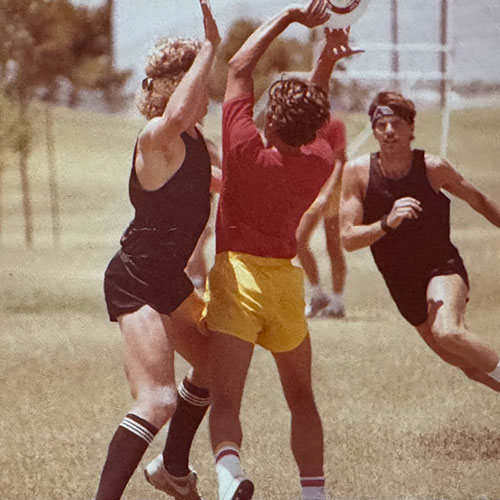
What is Ultimate Frisbee?
Ultimate is a fast-moving team sport played with a flying disc. It combines the running and field movement of soccer, the passing and spacing of basketball, and the end-zone scoring of football — but with a culture all its own.
The goal is simple: move the disc down the field by passing it from player to player, then score by catching it in the opposing team’s end zone. Players cannot run while holding the disc, so teamwork, timing, cutting, and communication are essential. When a pass is dropped, intercepted, knocked down, or thrown out of bounds, possession changes and the other team immediately attacks the opposite end zone.
One of the most important parts of Ultimate is Spirit of the Game. Ultimate is traditionally self-officiated, meaning players are responsible for knowing the rules, making calls fairly, and respecting opponents while competing hard. That combination of athleticism, strategy, and sportsmanship has shaped the sport from its beginning in 1968 to the college, club, youth, and international game played today.
WFDF describes Ultimate as a seven-a-side team sport played with a flying disc, where teams score by catching a pass in the end zone, and USA Ultimate’s current rules emphasize self-officiating and Spirit of the Game.
The History of Ultimate Frisbee
Joel Silver introduces the idea of Ultimate at Columbia High School in Maplewood, New Jersey.
The early players formalize rules, and Columbia High School plays Millburn High School.
Rutgers and Princeton play one of the first major college Ultimate games.
Texas Ultimate begins at the University of Texas in Austin.
Texas TUFF finishes second at College Nationals, helping raise the program’s national profile.
1968- The beginning of Ultimate
Ultimate began in 1968 at Columbia High School in Maplewood, New Jersey. Joel Silver brought the idea of a Frisbee-based team sport back from summer camp and introduced it to classmates. Alongside Bernard “Buzzy” Hellring and Jonny Hines, Silver helped shape the early version of the game, organize play, and develop the spirit that would define Ultimate.
What made Ultimate different from the beginning was not just the disc. It was the culture. The sport grew around athletic competition, creativity, teamwork, and self-officiating — values that became central to what is now known as Spirit of the Game.
The early spread of the sport
After its start at Columbia High School, Ultimate quickly moved from informal play to organized competition. Early players wrote rules, formed teams, and began playing against other schools. By the early 1970s, Ultimate had reached college campuses, where students helped spread the sport through tournaments, rivalries, and word of mouth.
This student-led growth became one of Ultimate’s defining patterns. The sport expanded because players built teams, taught newcomers, organized games, and carried the culture with them from one campus to the next.
Texas Ultimate launches
n 1978, Ultimate reached the University of Texas at Austin with the founding of Texas Ultimate. Like many early college programs, the team grew through student energy, pickup games, travel, and a commitment to building something new. Texas became part of the larger national expansion of Ultimate, as the sport moved from its East Coast beginnings into new regions and college communities.
The launch of Texas Ultimate marked an important step in the sport’s growth in the Southwest. It gave Austin a foundation for competitive Ultimate and helped create a community that would influence both college and club Ultimate in the years ahead.
Texas builds a national presence
After its founding, Texas Ultimate continued to grow into a nationally recognized college program. By the late 1980s, Texas TUFF was competing at the highest levels of college Ultimate, including a second-place finish at College Nationals in 1988 and another strong national run in 1989.
That success helped establish Texas as more than a new program. It showed that Ultimate had become a national sport, with serious teams emerging well beyond the places where the game first began.
Hall of Fame- People Who Shaped the Story of Ultimate
After its founding, Texas Ultimate continued to grow into a nationally recognized college program. By the late 1980s, Texas TUFF was competing at the highest levels of college Ultimate, including a second-place finish at College Nationals in 1988 and another strong national run in 1989.
That success helped establish Texas as more than a new program. It showed that Ultimate had become a national sport, with serious teams emerging well beyond the places where the game first began.

Joel Silver
Helped introduce and organize Ultimate at Columbia High School in 1968.

Bernard “Buzzy” Hellring
One of the early Columbia High School players who helped shape the rules and foundation of the sport.

Jonny Hines
An important figure in Ultimate’s early development at Columbia High School.

Pat “Bagger” Lee
A key figure in the growth of Texas and Austin Ultimate, connected to the rise of Texas Ultimate’s competitive presence.
Why This First Decade Matters
The story from 1968 to 1978 shows how Ultimate grew: not through major leagues or big institutions, but through students, teams, and communities. Columbia High School gave the sport its beginning. College campuses gave it momentum. Texas Ultimate’s launch in 1978 showed that the game had moved into a new phase — one where Ultimate was becoming a national community.
From a parking-lot game in New Jersey to a competitive college program in Austin, Ultimate’s first decade set the tone for everything that followed.